Washington
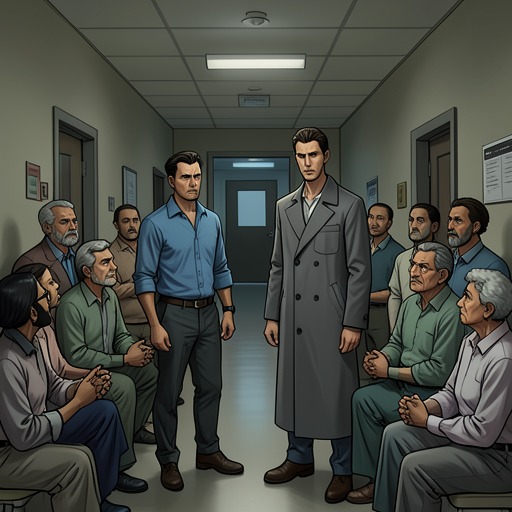
One Flew Over the Cuckoo's NestWashington is a ward aide whose attempt to force George Sorensen through a bathing procedure becomes a direct test of who controls the men’s bodies in the ward. His taunting of George turns care into humiliation; Randle Patrick McMurphy’s intervention then exposes the violence beneath that routine, and the encounter ends in a fight in which Washington strikes McMurphy and Chief Bromden takes on another aide.
Identity and Presentation
Washington is presented chiefly through his work as one of The ward's black aides, not through a personal history or private life. The narration first identifies him in the bathing-room confrontation by his scar: the place where his nose had been broken glows like neon. The scar is linked to a basketball game, a brief detail that gives him a history outside the immediate struggle without explaining more about it. His face and body are otherwise rendered through the scene’s attention to gestures: he touches the scar, spreads his fingers before George, and advances while holding a tube of cleaning solution.
The narration’s naming also matters. For much of the confrontation, Chief Bromden calls him “the black boy”; Randle Patrick McMurphy addresses him as Washington, and the narration then uses that name. That shift makes Washington individually recognizable within the ward’s staff, while the scene’s racial language remains part of how power is performed. The insults Randle Patrick McMurphy later directs at him do not simply describe the conflict; they make race an explicit and ugly instrument within it. Washington, for his part, treats those insults as familiar rather than as a reason to withdraw, presenting them as words the aides are trained to endure from patients.
The Procedure and George Sorensen
Washington’s most fully depicted action begins when George Sorensen objects to the prospect of bugs. Washington has been talking about bugs and then pretends to show George a crab, moving his fingers in front of George’s face. He warns that crabs could get onto the fishing boat and into George. The exchange plays on George’s fear of contamination: George shouts that there are no bugs and refuses to bend down for the cleaning solution.
Washington does not respond to that refusal by easing the pressure. He orders George to turn and bend, threatens to put his hand on him, and displays the hand as filthy. The tube is part of the procedure, but the threat becomes the focus: Washington uses the fear of contamination to make George submit to being touched. The scene therefore distinguishes the stated purpose of treatment from the manner in which it is imposed. What might be presented as routine care becomes an exercise in coercion, with George’s distress supplying the aides’ joke and Washington’s threat.
Conflict with Randle Patrick McMurphy
Randle Patrick McMurphy steps in and tells Washington to stop. Washington turns toward him, smiles at his nakedness, and remarks that he had begun to think they might never get to this confrontation. The exchange suggests that the conflict between the two has been anticipated, though the scene does not explain its full history. McMurphy answers with racial abuse, while Washington laughs with the other aides and frames the insults as an attempt to provoke him into taking the initiative. His composure is part of the contest: he appears to recognize the bait without allowing the exchange to end the procedure or release George.
When Randle Patrick McMurphy moves across and pushes Washington away from George, Washington presents the contact to the other aides as a reason he must protect himself. He sets the tube on the bench beside George, then punches McMurphy across the cheek. The placement of the tube marks a turn in the action: Washington stops threatening George with the cleaning solution and directs his force at McMurphy. He hits McMurphy again before McMurphy can steady himself; McMurphy then catches a later swing and holds Washington by the wrist. The nude line of men becomes a shouting circle around them, changing the bathing-room routine into a collective spectacle.
Chief Bromden and the Aftermath
Chief Bromden takes part in the fight, and Randle Patrick McMurphy later tells the nurse that Washington was the one who fought him while Chief Bromden handled Warren. That brief division of the struggle gives Washington a specific place in the outcome without suggesting that he alone controlled the whole encounter. Earlier, Chief Bromden had broken his long silence to thank Randle Patrick McMurphy, an intimate moment between the two; here, his participation in the fight provides a physical counterpart to that newly spoken connection.
The aftermath shows the immediate cost rather than a formal resolution. Randle Patrick McMurphy is exhausted, and the nurse removes the men’s cuffs, gives him a cigarette, and treats his cuts and knuckles with salve. She asks whether Washington or Warren was responsible for the injuries, and McMurphy identifies Washington. The narrative does not provide a separate account of punishment or later change in Washington’s position. His significance rests instead in this sharply drawn episode: he enforces the ward’s procedure through ridicule and threatened touch, then meets resistance with direct violence when Randle Patrick McMurphy intervenes.